
Course unit contents
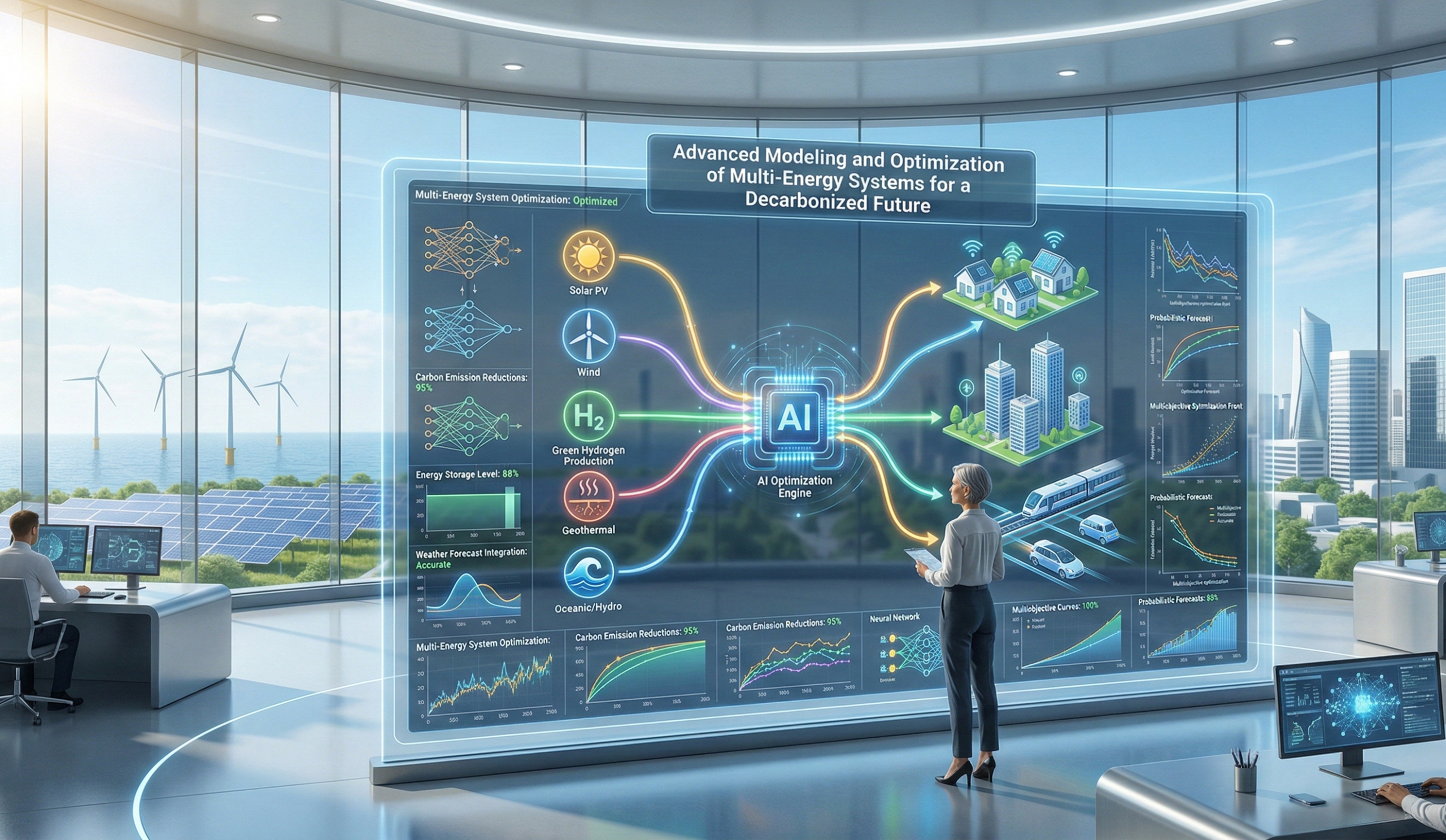
The course addresses the critical challenge of optimally integrating new renewable energy units into existing energy systems and networks to drive the transition toward a decarbonized future. It focuses on the concept of “Multi-Energy Systems” (MES), where different energy carriers interact to increase system flexibility and accommodate higher shares of renewable energy. These interactions occur through various energy conversion, storage, and consumption units. Shifting the approach from optimizing individual units as separate entities to optimizing the design and operation of an MES as a whole is pivotal to achieving greener energy systems in a more cost-effective, efficient, and environmentally friendly manner.
The course is organized into three 5-hour modules and combines classroom lectures with practical, computer-based sessions.
- Module 1: Introduction to the concept of Multi-Energy Systems. Modeling of MES components, including energy conversion units, storage systems, and energy demands. Derivation of linear models for MES components. Fundamentals of variable and equation structures in Python, followed by the practical implementation of these models in a Python environment.
- Module 2: Introduction to engineering optimization and optimization algorithms. Formulation of the Synthesis, Design, and Operation (SDO) optimization problem for an MES, including deterministic optimization approaches and the coupling between energy demand and availability curves. Definition of objective functions to maximize energy savings, cost-effectiveness, and environmental benefits, concluding with a discussion of real-world applications.
- Module 3: Integration of individual MES component models into a comprehensive optimization model for the entire system. Fundamentals of structuring decision variables, constraints, objective functions, and optimization algorithms using the Gurobi solver. Practical examples of design and operation optimization for an MES within a Python-Gurobi environment.
Learning goals
Upon successful completion of this course, students will be able to understand the general modeling features of energy systems of varying complexity, grasp the fundamental principles of energy system optimization, implement these optimization models within a Python-Gurobi environment, and critically analyze the results obtained from practical implementations.