
Course contents
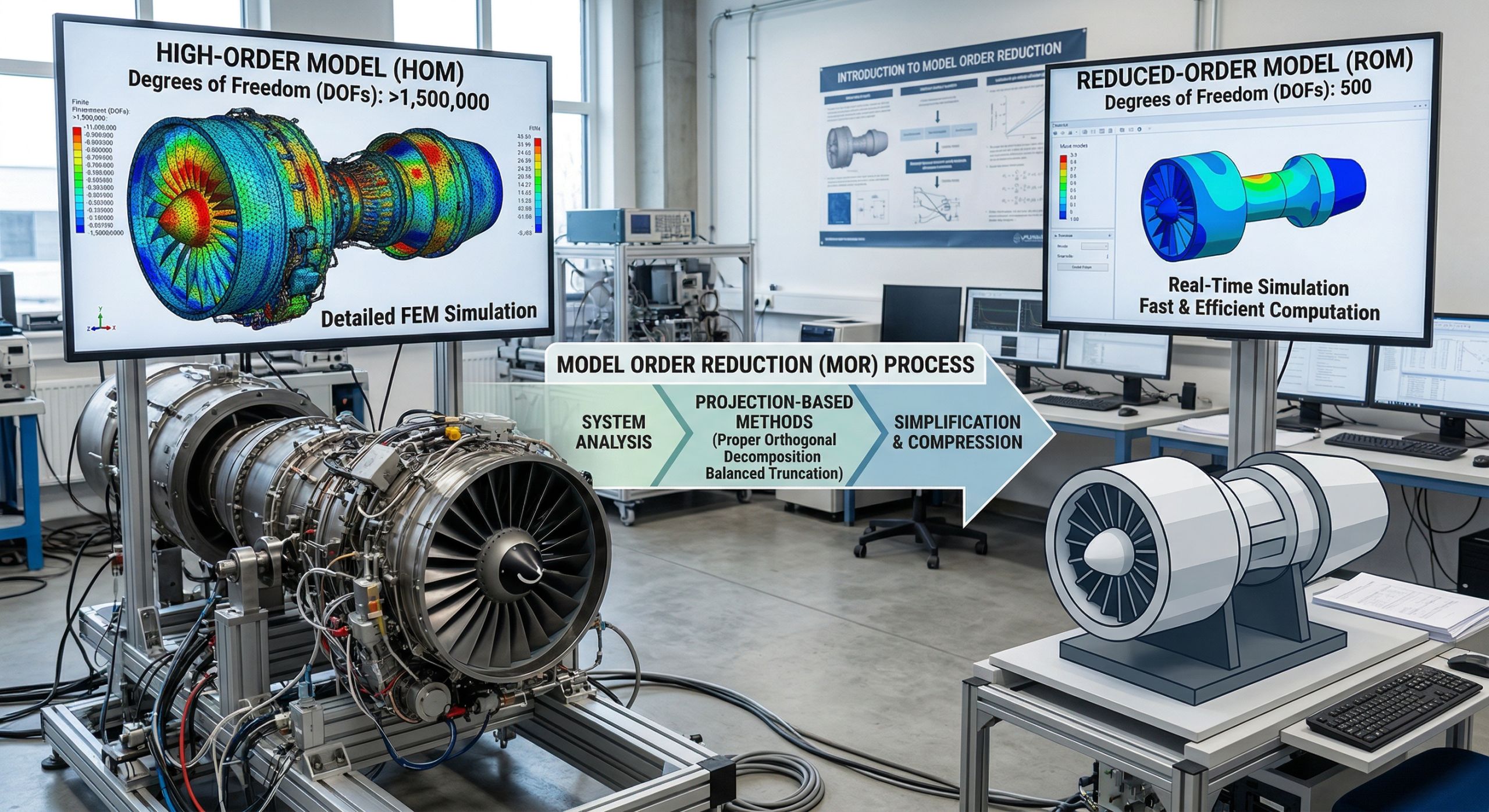
Model Order Reduction (MOR) is a key technique for decreasing the computational complexity of mathematical models in numerical simulations. This course explores the relationship between MOR and metamodeling, highlighting its versatile applications across all areas of mathematical modeling and engineering where high-fidelity simulations are required.
The curriculum introduces the main numerical approaches used to perform Model Order Reduction, with a detailed focus on the Proper Orthogonal Decomposition (POD). Students will examine the theoretical foundations of the POD algorithm and its practical implementation. The course features a hands-on component where the POD algorithm is applied to accelerate time-domain simulations of thermal problems using MATLAB, demonstrating the real-world impact of MOR on large-scale numerical simulations.

Learning goals
Upon completion of the course, participants will acquire a comprehensive understanding of the primary numerical techniques for Model Order Reduction. Specifically, PhD students will develop the ability to apply these methods to dynamic models, enhancing computational efficiency while maintaining high accuracy in simulation results.
Suggested readings
- Benner P., Grivet-Talocia S., Quarteroni A., Rozza G., Schilders W., Magdeburg L. M. S. Model Order Reduction. Three volumes. Doi: 10.1515/9783110499001
- Benner, P., Feng, L. (2014). A Robust Algorithm for Parametric Model Order Reduction Based on Im- plicit Moment Matching. In: Quarteroni, A., Rozza, G. (eds)
- Reduced Order Methods for Modeling and Computational Reduction. MS&A – Modeling, Simulation and Applications, vol 9. Springer, Cham. https://doi.org/10.1007/978-3-319-02090-7_6
- Feng, L., Yue, Y., Banagaaya, N. et al. Parametric modeling and model order reduction for (electro-)thermal analysis of nanoelectronic structures. J.Math.Industry 6, 10 (2016).
- Y. Liang, H. Lee, S. Lim, W. Lin, K. Lee, and C. Wu. Proper orthogonal decomposition and its applica- tions—part i: Theory. Journal of Sound and Vibration, vol. 252, no. 3, pp. 527–544, 2002
- S. Brunton, J. Nathan Kutz, Data-Driven Science and Engineering. Doi: https://doi.org/10.1017/9781108380690