
Course contents
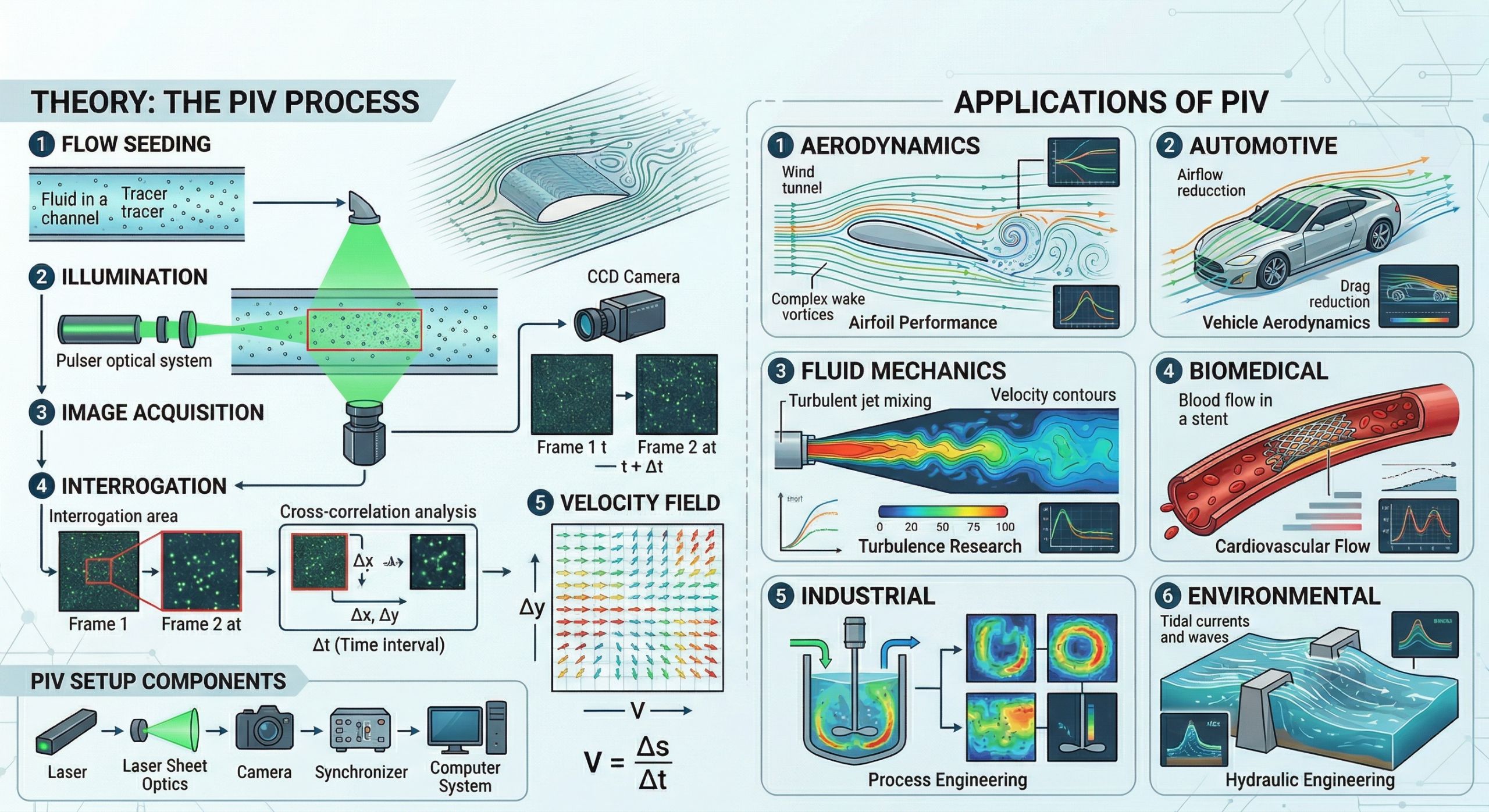
Particle Image Velocimetry (PIV) has evolved from a specialized, high-cost tool into a widely accessible optical measurement technique across numerous engineering disciplines. This course examines the principles of PIV as a minimally intrusive diagnostic method for fluid dynamics research, highlighting how advancements in sCMOS digital sensors and laser sources have broadened its application in both academic and industrial facilities.
The curriculum integrates theoretical foundations with practical experimental strategies, covering component selection criteria to optimize system setups for specific fluid dynamic problems. While focusing on fundamental configurations such as 2D Mono and Stereo PIV, the course also introduces advanced modalities, including Dual Pane, Tomographic PIV (Tomo-PIV), and particle tracing techniques. The programme concludes with an intensive experimental activity, involving students in every stage of a PIV campaign: from camera positioning and calibration to real-time data acquisition. Special emphasis is placed on the application of sophisticated pre- and post-processing filters to recording data, ensuring that participants can extract high-quality velocity fields and valid physical insights from their experimental measurements.

Learning goals
The main learning objectives are to understand the multidisciplinary nature of PIV and the physical principles (including geometric and physical optics) that underpin its operation. PhD candidates will develop the methodology required to critically evaluate experimental designs and set up high-fidelity PIV campaigns. This includes the strategic selection of equipment and the application of advanced post-processing algorithms to optimize the study of complex flow phenomena.
Suggested readings
Particle Image Velocimetry – a practical guide. M Raffel, C. Willert, S. Wereley and J. Kompenhans. ISBN 978-3-540-72307-3 Second Edition Springer Berlin Heidelberg New York.