
Course contents
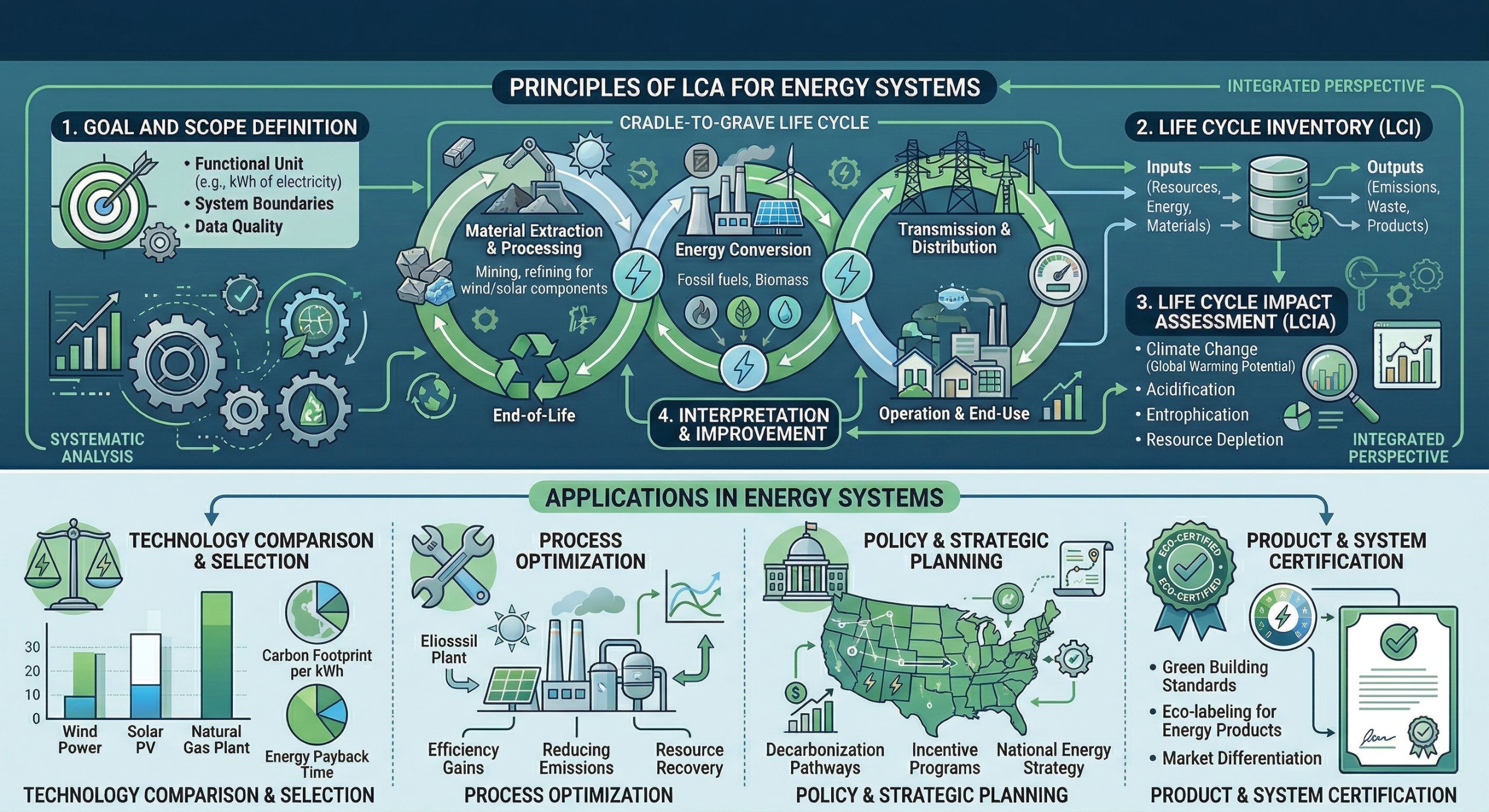
This course provides an advanced exploration of Life Cycle Assessment (LCA) methodologies, following the international standards ISO 14040 and 14044. The programme focuses on the environmental evaluation of energy systems, providing doctoral candidates with the analytical tools to monitor and improve the sustainability performance of products and services throughout their entire life cycle.
The curriculum covers the four fundamental stages of LCA: goal and scope definition, inventory analysis, impact assessment, and interpretation. Students will examine the most widely used models and updated databases for inventory analysis, specifically focusing on the proper evaluation of reference systems for electricity and heat production. The course also explores the role of LCA within the context of environmental labeling systems. Through several case studies, the programme highlights the critical importance of defining functional units, system boundaries, and data quality requirements. Significant attention is given to allocation methods and the selection of appropriate impact categories. The course concludes with a hands-on module using SimaPro, a professional tool for monitoring sustainability performance. Students will apply the software to conduct a complete Life Cycle Analysis of a Renewable Plant, bridging theoretical knowledge with practical industrial application.

Learning goals
By the conclusion of the course, PhD students will master the fundamental knowledge and principles required to conduct a rigorous Life Cycle Assessment. Participants will develop advanced capabilities to perform basic LCA analyses, interpreting complex environmental data to support sustainable decision-making. Furthermore, students will gain proficiency in using professional sustainability tools to assess energy systems and renewable plants.
Suggested readings
- Stoppato A., Benato A., De Vanna F. (2021), “Environmental impact of energy systems integrated with electrochemical accumulators and powered by renewable energy sources in a life-cycle perspective”, Applied Sciences, Volume 11, Issue 62.
- Stoppato A. and Benato A. (2020), “Life cycle assessment of a commercially available organic Rankine cycle unit coupled with a biomass boiler”, Energies 13(7),1835.
- Cavallin Toscani A., Stoppato A., Benato A. (2019), “LCA of a concert: Evaluation of the Carbon footprint and of Cumulative energy demand”, ECOS 2019 – Proceedings of the 32nd International Conference on Efficiency, Cost, Optimization, Simulation and Environmental Impact of Energy Systems pp. 3203-3213.
- Fantinato, D., Stoppato A., Benato A. (2019), “LCA analysis of a low-energy residential building”, ECOS 2019 – Proceedings of the 32nd International Conference on Efficiency, Cost, Optimization, Simulation and Environmental Impact of Energy Systems pp. 3153-3165.
- Stougie, L., Giustozzi, N., van der Kooi, H., Stoppato, A. (2018), “Environmental, economic and exergetic sustainability assessment of power generation from fossil and renewable energy sources”, International Journal of Energy Research 42(9), pp. 2916-2926.
- Stoppato A. (2008), “Life cycle assessment of photovoltaic electricity generation”, Energy 33(2), pp. 224-232.