
Course unit contents
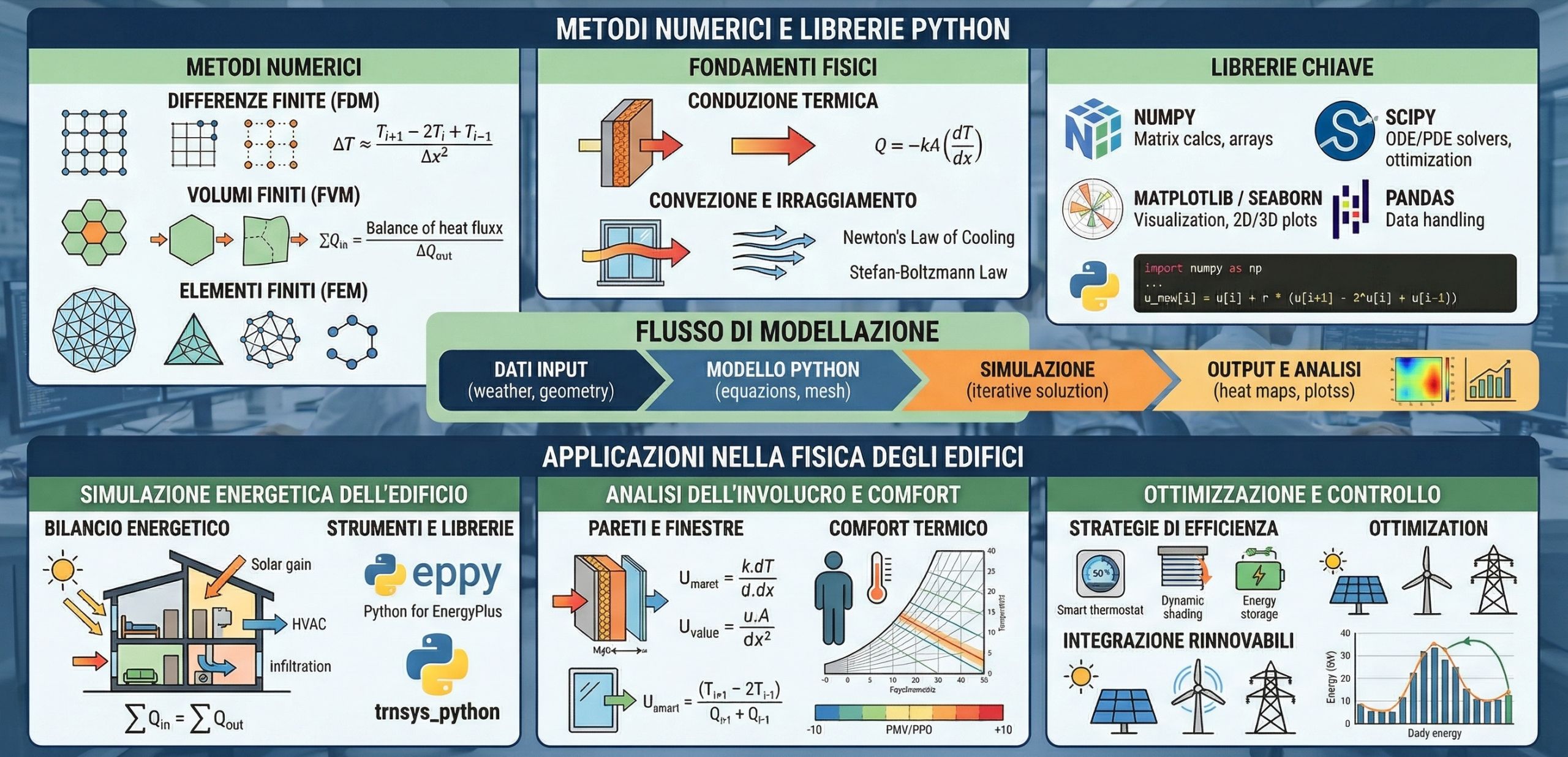
Despite the rapid rise of data-driven methodologies, physics-based modeling remains a crucial, flexible, and adaptable tool for engineering research. This course provides a practical introduction to transient heat transfer and building physics modeling, leveraging the Python programming language to bridge theoretical foundations with computational implementation.
The programme begins with a brief introduction to Python, covering data structures, control loops, essential libraries, and data visualization. Students will then progress to developing their first models, specifically investigating 1D heat transfer through solid elements and the dynamics of radiant panels. The course extends into more complex architectural modeling, including the development of Resistance-Capacitance (RC) networks for whole-building simulations and an introduction to model calibration techniques. The course concludes with a project discussion, where students present and refine their simulations of real-world scenarios—such as radiant floor heat flux and transient building behavior—ensuring a deep understanding of the practical guidelines required for high-fidelity physical modeling.
Learning goals
Participants will master the basic principles of establishing and solving physics-based systems using both implicit and explicit numerical solution schemes. A primary objective is to develop proficiency in Python for scientific applications, enabling PhD students to translate physical laws into robust simulation models for transient thermal phenomena.
Suggested readings
- Transition from MATLAB to Python. https://www.enthought.com/wp-content/uploads/2019/08/Enthought-MATLAB-to-Python-White-Paper_.pdf
- Think Python. https://greenteapress.com/wp/think-python-2e/Physics modeling
- ASHRAE Fundamentals. Incropera F., De Witt D. Fundamentals of Heat Transfer, John Wiley&Sons. 1981 or other edition.
- Building Physics – Applications in Python. https://www.researchgate.net/publication/353514722_Building_Physics_-_Applications_in_Python
- Solving inverse problems in building physics: an overview of guidelines for a careful and optimal use of data. https://srouchier.github.io/files/2018-enb-review.pdf